BONE GRAFT MATERIAL · BOVINE / XENOGENEIC
RE-BONE®
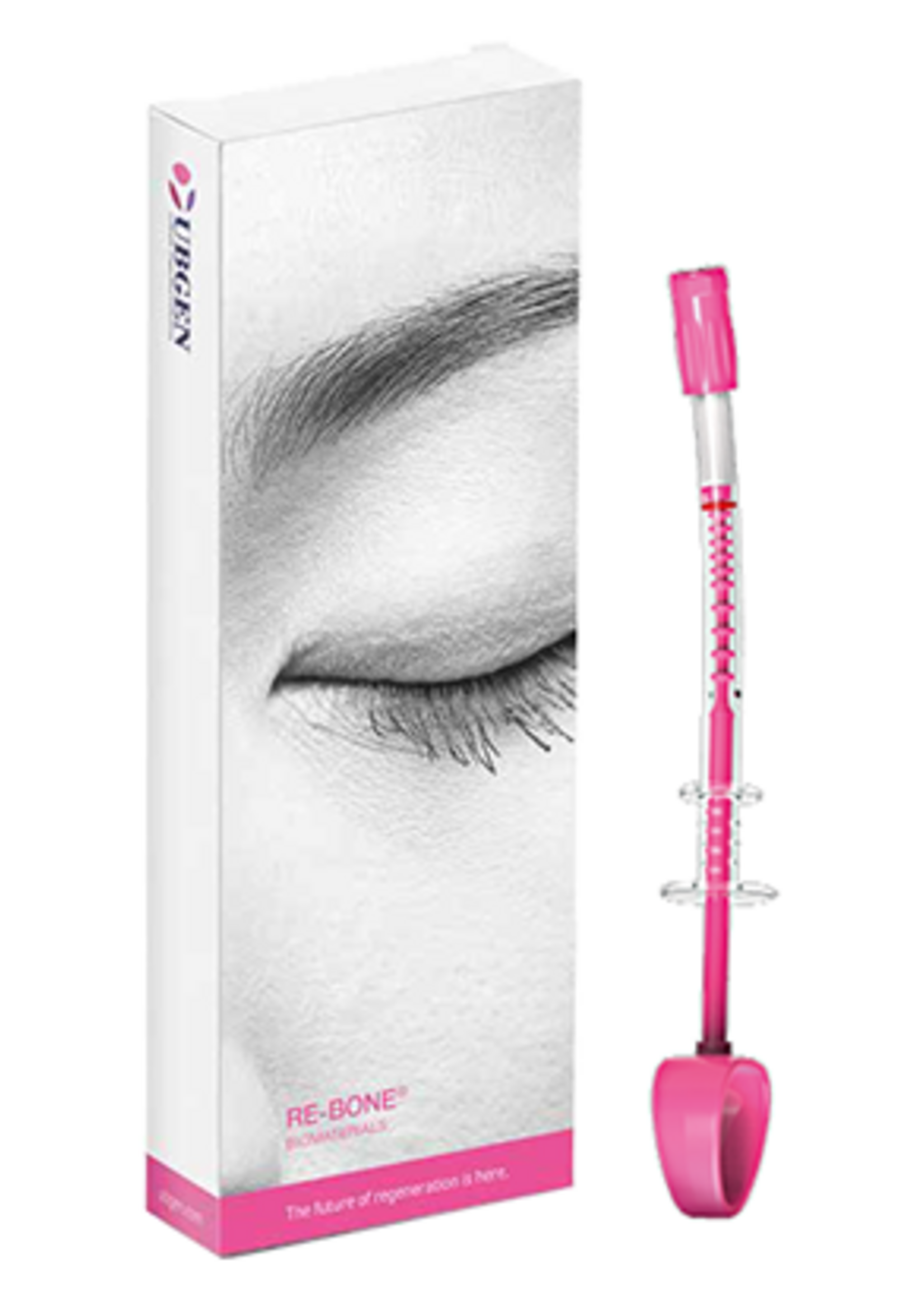
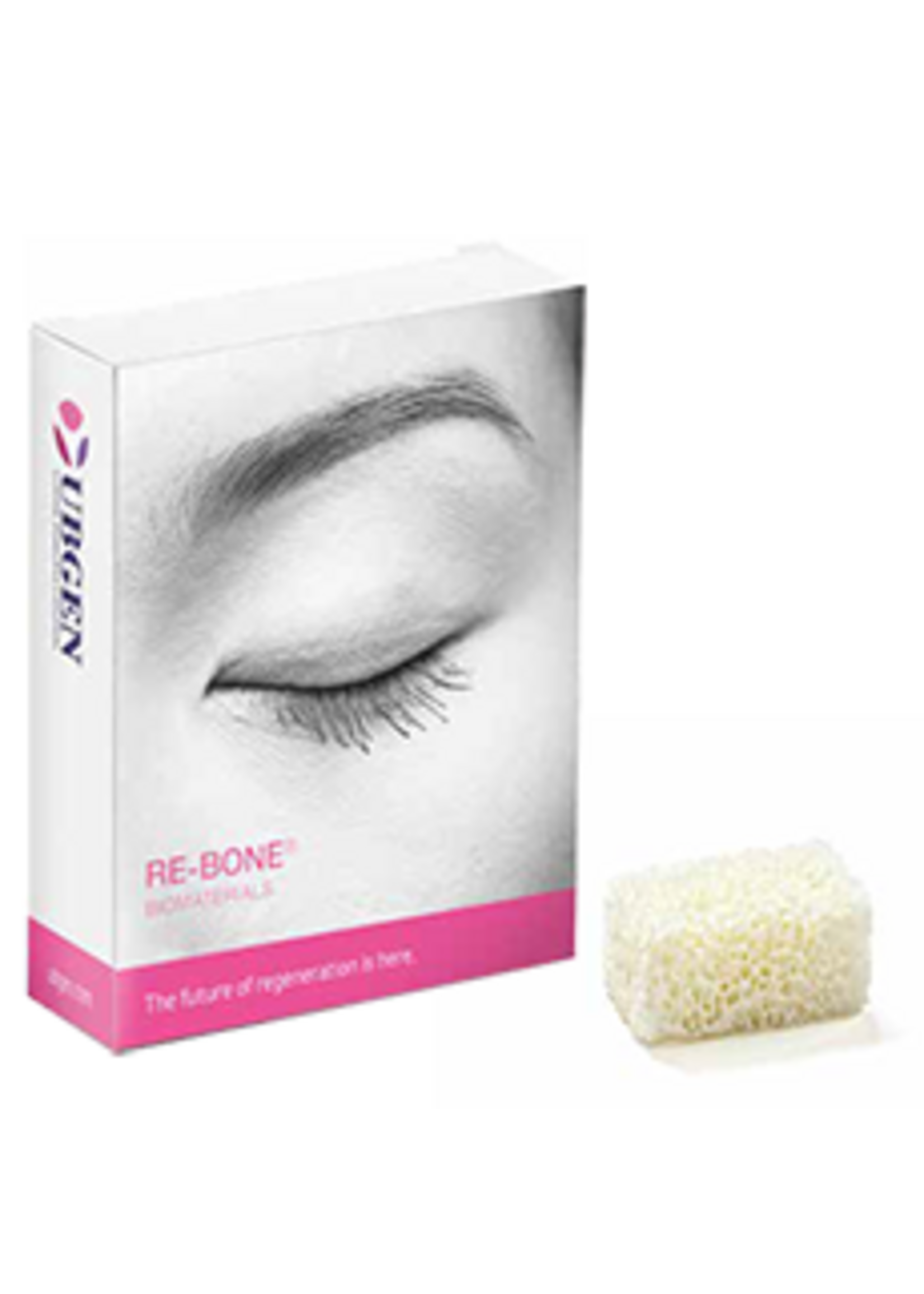
Resorbable bovine bone graft material processed using the THERMAGEN® low-temperature treatment to support bone regeneration.
ORIGIN
Bovine
Natural bovine bone matrix
PROCESSING
THERMAGEN®
Low-temperature processing
STRUCTURE
Highly porous
Preservation of the natural bone matrix
RESORPTION
approx. 6–8 months*
Manufacturer information
Available forms: Granules · Syringe · cancellous block · Particle sizes: 0.25–1 mm and 1–2 mm
What distinguishes RE-BONE®?
RE-BONE® is manufactured from bovine bone and processed at low temperatures using the THERMAGEN® process. The low-temperature treatment is intended to preserve the natural porous bone matrix and avoid ceramization caused by high temperatures.
The preserved macro- and microporosity provides an osteoconductive scaffold for bone regeneration. UBGEN states an average resorption time of approximately 6–8 months for RE-BONE®.*
FOR CLINICIANS
Use in regenerative dentistry
RE-BONE® serves as an osteoconductive scaffold to support bone regeneration. Different compositions, particle sizes, as well as syringe and block formats allow selection according to defect morphology and the surgical concept.
Areas of application stated by the manufacturer include:
- Alveolar preservation / ridge preservation
- Sinus floor elevation
- Horizontal and vertical augmentation
- Periodontal defects
- Filling of cystic defects
PRODUCT SELECTION GUIDANCE
Which RE-BONE® variant?
The treating dentist selects the composition, particle size and delivery form according to defect size, defect morphology, augmentation concept and preferred handling. The following information is intended as professional guidance for product selection.
FINER PARTICLES
0.25–1 mm
Finer particles can be readily adapted to smaller and irregular defect geometries. This particle size therefore represents a versatile option for small to medium-sized, readily adaptable defects.
COARSER PARTICLES
1–2 mm
Coarser granules are available for larger defects and applications requiring correspondingly greater material volumes. RE-BONE® offers cancellous and cortico-cancellous variants for these applications.
DELIVERY FORM
Syringe
Following the specified rehydration procedure, the pre-filled syringe enables controlled and direct application of the granules.
MATERIAL STRUCTURE
Cancellous or cortico-cancellous?
Cancellous
The porous cancellous structure provides a large internal surface area and good blood absorption. These characteristics can be considered during material selection, particularly with regard to the biological healing environment.
Cortico-cancellous / mixed
Cortico-cancellous material combines the porous structure of cancellous components with denser cortical components. This combines different characteristics relating to blood absorption, adaptability, particle stability and volume support.
VERSATILE VARIANT
Cortico-cancellous · 0.25–1 mm
0.5 g · 0.90 cc · BMrebone01B
The combination of cancellous and cortical components, fine particle size and a convenient pack size makes this variant a versatile choice for a broad range of augmentation procedures.
Note: This variant is regularly stocked by ImplAg.
PRODUCT OVERVIEW
Available variants & order numbers
Overview of granules, syringes and cancellous blocks.
| Form |
Composition / particle size |
Content |
Volume |
Article number |
| Granules |
Cortico-cancellous · 0.25–1 mm |
0.5 g |
0.90 cc |
BMrebone01B |
| Granules |
Cancellous · 1–2 mm |
1 g |
1.9 cc |
BMrebone01N |
| Granules |
Cortico-cancellous · 1–2 mm |
1 g |
1.9 cc |
BMrebone01F |
| Syringe |
Cortico-cancellous · 0.25–1 mm |
0.25 g |
0.45 cc |
BMrebone03A |
| Syringe |
Cortico-cancellous · 0.25–1 mm |
0.5 g |
0.90 cc |
BMrebone03B |
| Syringe |
Cortico-cancellous · 1–2 mm |
0.5 g |
0.95 cc |
BMrebone03C |
| Block |
Cancellous · 10 × 10 × 10 mm |
– |
– |
BMrebone02A |
| Block |
Cancellous · 10 × 10 × 20 mm |
– |
– |
BMrebone02B |
| Granules · on request |
Cortico-cancellous · 1–2 mm |
5 g |
– |
BMrebone01H |
PRACTICAL GUIDANCE
Quantity guidance for product selection
The actual amount of material required cannot be determined solely by the number of implants. Defect size and morphology, existing bone walls, desired contour and augmentation volume all influence the amount required.
| Example situation |
General guidance |
| Small, localized dehiscence of approximately 3 mm with favorable defect geometry |
0.25 g may be sufficient |
| Buccal contour augmentation extending over a larger portion of the implant length |
consider approximately 0.5 g |
| Multiple implants or larger horizontal augmentation |
0.5–1 g or more · individually determined |
The quantities stated are intended solely as general guidance for selecting the appropriate pack size and do not constitute patient-specific dosing recommendations.
GBR & MEMBRANE
With or without a membrane?
The use of a membrane depends, among other factors, on defect morphology, augmentation stability, the soft-tissue situation and the selected GBR concept. A membrane may be used to separate the augmented area from ingrowing soft tissue and to help stabilize the augmented space.
RESORPTION & REMODELLING
What does the resorption time mean?
UBGEN states an average resorption time of approximately 6–8 months.* The individual course is additionally influenced by the defect situation, vascularization, augmentation stability and individual healing. No general patient-specific healing or waiting period can be derived from this information.
Practical application
Rehydration
The granules can be rehydrated with physiological saline solution. According to the manufacturer, patient blood or platelet concentrate may also be used for rehydration of the syringe format.
Granules
The granules are adapted to the defect geometry. Overfilling should be avoided to facilitate tension-free wound closure.
Syringe
Following the specified rehydration procedure, the pre-filled application syringe enables direct placement of the granules into the defect.
Clinical planning
Implant planning should consider bone volume, bone quality, defect size and morphology, as well as the intended prosthetic implant position. Selection of the material variant, particle size, material quantity, membrane and surgical approach remains subject to the clinical assessment of the treating dentist.
Note: Manufacturer-related product and application information is subject to the current Instructions for Use and product documentation. Additional information regarding material, quantity and procedural selection is provided for professional guidance only and does not constitute an individual treatment recommendation.
* Average resorption time according to the manufacturer. Individual biological and clinical outcomes may vary.